

There’s no single reason the Greater Vancouver real estate market has slowed down.
We’ve had higher borrowing costs, affordability challenges, a softer economy, slower population growth and plenty of uncertainty. Add the Trump factor, particularly U.S. tariffs and ongoing trade uncertainty, and there are a lot of macroeconomic forces at play. The Bank of Canada recently noted that renewed U.S. tariffs and threats of further trade measures are weighing on consumer and business confidence and could dampen spending, investment and hiring.
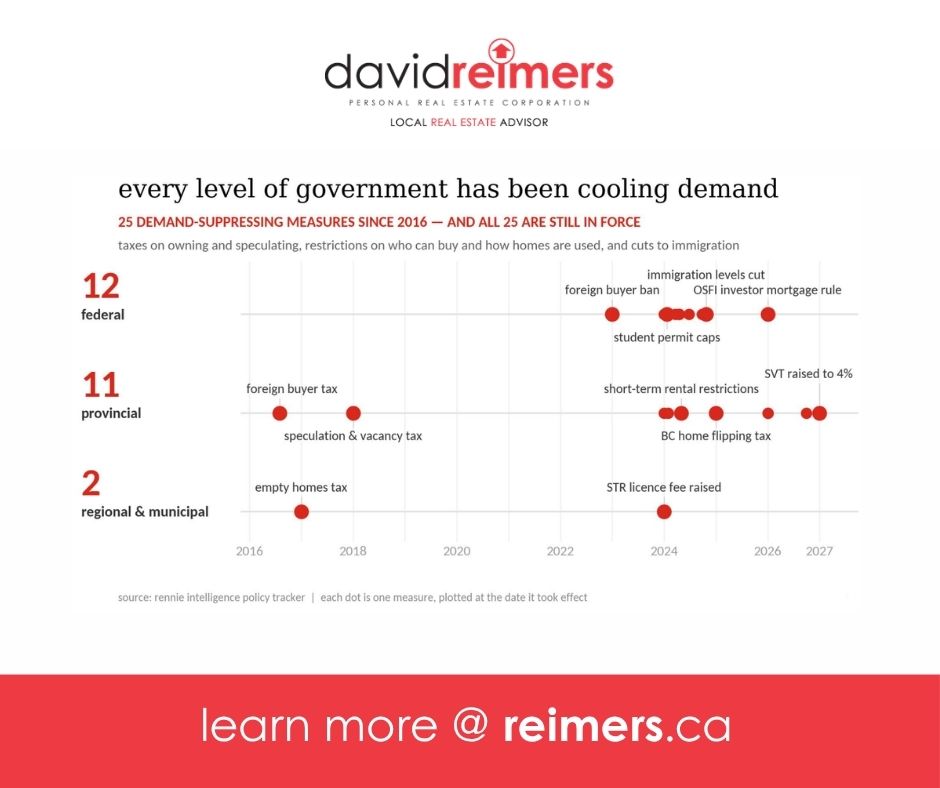
But this chart highlights another part of the story: just how much government intervention there has been in the housing market.
The policy tracker identifies 25 demand-suppressing measures introduced since 2016 at the federal, provincial and municipal levels.
Foreign Buyer Tax: B.C. introduced an additional property transfer tax on foreign purchasers in Metro Vancouver in August 2016. It originally started at 15% and was subsequently increased and expanded.
Empty Homes Tax: Vancouver introduced its Empty Homes Tax in 2017 to encourage empty and under-used homes to return to the long-term housing supply. The current tax rate is 3% of assessed taxable value for properties subject to the tax.
Speculation and Vacancy Tax: B.C.'s Speculation and Vacancy Tax applies to certain residential properties in designated areas. For 2026 onward, the rate is 3% for foreign owners and untaxed worldwide earners and 1% for other taxable Canadian citizens and permanent residents.
Foreign Buyer Ban: The federal government introduced restrictions on many non-Canadians purchasing residential property beginning in 2023. The prohibition has been extended until January 1, 2027, although there are exemptions.
Short-Term Rental Restrictions: B.C. introduced a principal-residence requirement for short-term rentals in many communities. Generally, where the requirement applies, short-term rentals are limited to the owner's principal residence plus one secondary suite or accessory dwelling unit, with various exemptions.
B.C. Home Flipping Tax: Since January 1, 2025, the B.C. home flipping tax can apply to taxable properties sold within 730 days of purchase. The rate is 20% of net taxable income for properties sold within the first 365 days and gradually declines to zero by 730 days, subject to exemptions.
Investor Mortgage Regulation: OSFI's capital rules treat certain income-producing residential mortgages differently when repayment depends materially on rental income. Importantly, OSFI says these rules do not change how borrowers qualify for mortgages or prevent investors from using rental income to qualify.
International Student Caps: The federal government introduced an international student cap in 2024. For 2026, IRCC expects to issue up to 408,000 study permits, including extensions, which is below its 2025 and 2024 targets.
Lower Immigration Levels: Canada has also substantially reduced planned temporary-resident arrivals. The target falls from 673,650 new temporary resident arrivals in 2025 to 385,000 in 2026, while permanent resident admissions are targeted at 380,000 annually from 2026 through 2028.
None of these policies on their own explains today's real estate market. Interest rates, affordability, employment, the broader economy, population growth and U.S. trade uncertainty are all part of the equation. But when you look at the policies together, it is pretty striking just how much government involvement in housing has increased over the past decade.
Whatever your view of the individual policies, the housing market of 2026 operates in a very different regulatory environment than it did in 2016.

 The data relating to real estate on this website comes in part from the MLS® Reciprocity program of either the Greater Vancouver REALTORS® (GVR), the Fraser Valley Real Estate Board (FVREB) or the Chilliwack and District Real Estate Board (CADREB). Real estate listings held by participating real estate firms are marked with the MLS® logo and detailed information about the listing includes the name of the listing agent. This representation is based in whole or part on data generated by either the GVR, the FVREB or the CADREB which assumes no responsibility for its accuracy. The materials contained on this page may not be reproduced without the express written consent of either the GVR, the FVREB or the CADREB.
Comments:
Post Your Comment: